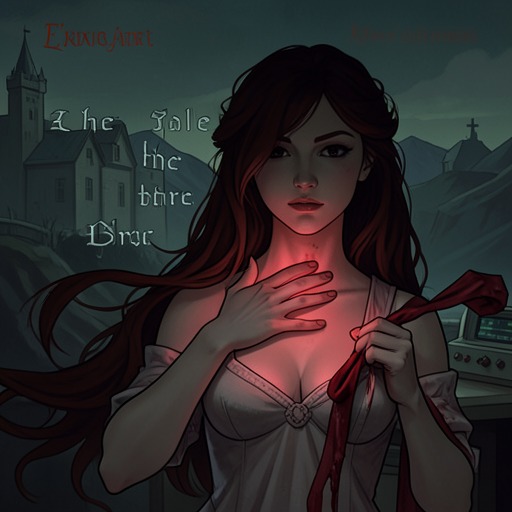
Master–Progeny Blood Bond
The Tale of the Vampire BrideThe Master–Progeny Blood Bond is the supernatural tie through which Vlad Dracula claims authority over Glynis Wright, his progeny. It is not presented as a simple affection or a purely physical connection: it makes itself felt as a call she must answer, a force that can pull her toward Vlad, and a relationship whose pressure persists even when she resists him. Its significance lies in the contradiction at its center. The bond gives Vlad a means to command Glynis, but her awareness of that control also becomes part of her effort to understand and eventually oppose her captivity.
The Bond as Call and Compulsion
Vlad explains that Glynis has learned the power of the beckoning: when he calls, she must come to him. The command is framed as an enduring rule, not a request that she can freely accept or refuse. In the same conversation, he promises that in Buda she will have freedoms denied to her at the castle, including hunting on her own and learning the powers of the night. Yet those permissions do not end his claim. He presents them as part of a test of her loyalty and as preparation for the position he intends her to occupy as his true bride. Freedom within the arrangement is therefore conditional: Glynis may gain room to act, but Vlad retains the right to summon her and defines the purpose of her advancement.
The bond becomes physically vivid when Glynis is in pain and struggling to stand. She feels an invisible cord tying her to Vlad and pulling her after him. When she asks him to release her from the pain, she falls against him and catches hold of his medallion to keep from falling. The contact makes the bond flare hot inside her, then ebb away; she can stand trembling, fully released from the power of his call. Vlad brushes her aside and continues through the castle, while Glynis follows with irritation. The episode gives the bond a bodily rhythm—pull, flare, release—without suggesting that its temporary easing amounts to a lasting escape from his authority.
Blood, Injury, and the Limits of Escape
The bond’s reach is also apparent when Glynis is badly wounded by blessed knives. With the sun approaching, she cannot leave the place where she is being sheltered, and she is told that the wound is severe and that she cannot heal herself. In agony, she begs for help and invokes Vlad as her Master. The vampire tending her says that Vlad could help, but is not present; the vampire may be strong enough to do so instead. That offer carries a danger: the vampire fears Vlad may sense his blood in Glynis’s veins. The scene makes the bond more than a distant command. Another person’s attempt to save her may be detectable through the blood relationship that links her to her Master, so even care can carry the risk of alerting Vlad.
Glynis’s account of her captivity also distinguishes the blood bond from the full range of Vlad’s power over her. She tells Ignatius that Vlad’s control is not merely a matter of his blood: he can strike at what is most precious to her. She understands herself as a faithful slave who cannot defy him, and expects cruel punishment when she returns, though she believes he will not kill her because he needs her. The bond thus belongs to a wider system of coercion. Its supernatural hold is real, but so are the threats and dependencies that make resistance costly. Treating every form of control as an automatic effect of the bond would flatten this distinction; Glynis herself identifies additional leverage beyond blood.
Bridehood, Obedience, and Negotiated Freedom
The bond is closely entangled with Vlad’s plans for Glynis as a bride. He tells her that he wants her loyalty and hopes she will rise to become his true bride, while promising to share secrets when she learns to love him. His language combines intimacy with possession: affection is offered within a hierarchy in which he remains Master and decides what Glynis may know or do. Later, when Vlad calls for the new Bride, Cneajna insists that Glynis must go because it is her duty. Glynis refuses, saying she will not let him touch her again, but Cneajna pulls her toward the door and commands her not to defy either of them. This moment shows how the household’s expectations of bridal obedience support Vlad’s authority, even when the command is relayed by another bride rather than enacted through a visible supernatural summons.
Vlad’s instructions for the journey to Buda further show how autonomy is granted and managed. Glynis is told to wear dresses bought by her mother in Paris and jewelry belonging to Erzsébet Dolingen, rather than clothing her brother, Andrew Wright, would recognize. A veil is to conceal her changed appearance from him. After the arrival, the veils made for her become a continuing restriction: Vlad orders her to wear one around Andrew, and she grows frustrated that the layers of organza and lace prevent her from truly seeing him. These arrangements are not themselves identified as powers of the blood bond, but they reveal the practical world in which the bond operates. Vlad’s authority extends into the presentation of Glynis’s body and the terms under which she can meet her family.
Intimacy, Ambivalence, and Meaning
The bond does not erase Glynis’s capacity for attachment or make her feelings consistent. In her relationship with Ignatius, she experiences tenderness and mutual desire, yet explains that Vlad’s hold prevents her from freely defying him. Ignatius and Glynis make plans to meet again, but her promise is shadowed by the knowledge that leaving and returning are dangerous. Her resistance therefore takes place inside a relation she cannot simply sever by choosing another love.
Glynis’s later response to Vlad is similarly divided. She resents the bond and the anger it produces in her, but admits that on one night it comforts her. Vlad declares that she is his wife and that he will not share her; she recognizes the force of the tie even as she tries not to think of Ignatius. The comfort does not cancel the coercion, just as the coercion does not make every moment of closeness unreal. The concept is most revealing when it holds these opposites together: the bond is a supernatural mechanism of command, a structure reinforced by bridehood and threat, and an intimacy Glynis can feel without mistaking it for freedom. Its emotional contradictions expose the difference between being attached to someone and possessing the power to refuse him.